
Marketing Budget Optimization for UAE SMEs
Learn marketing budget optimization in the UAE: allocation, measurement, and 7 steps to reallocate spend for ROI and pipeline growth.

Adam Taylor
Fractional CMO & Marketing Strategist[Published: Feb 25, 2026]
[Reading time: ]
In this article:
Introduction The UAE Budget Reality in 2025–2026 My POV: Why Most “Budget Optimization” Advice Fails in the UAE The Action Plan: 7 Steps to Optimize Spend and Grow Conclusion Executive checklist FAQsIntroduction
Most UAE SMEs don’t have a “budget” problem. They have a budget confidence problem.
The reality: marketing budgets are under pressure globally, and the CFO’s tolerance for “trust me” spend is shrinking. Gartner’s 2025 CMO Spend Survey found marketing budgets are flat at 7.7% of company revenue, unchanged from 2024. When budgets don’t grow, the only way to scale is to allocate better, measure tighter, and reallocate faster.
That’s exactly where marketing budget optimization becomes a competitive advantage. In Dubai and Abu Dhabi, customers compare brands in seconds, conversion often happens through web, phone or WhatsApp, and competition inflates paid media costs. If you don’t know which 20% of spend is driving 80% of pipeline, you’re not optimizing, you’re guessing.
My view: the winning UAE SMEs won’t be the ones who “spend more.” They’ll be the ones who build an evidence-led system to turn spend into predictable pipeline, and can prove it month after month.
The UAE Budget Reality in 2025–2026
The global budget squeeze is real, so “more spend” is the wrong default
Even large brands are operating in a constrained environment. Gartner reports marketing budgets in 2025 remain at 7.7% of overall company revenue. For SMEs, that pressure shows up as: shorter decision cycles from owners, tighter cashflow, and marketing being asked to justify itself like a sales function.
Implication for UAE SMEs: budget optimization is less about “cutting,” and more about shifting money from low-confidence activity to high-confidence activity.
Measurement maturity is now the growth limiter
A major reason SMEs struggle to optimize is measurement fragmentation. You might have:
- Website leads attributed to “Direct” or “Organic”
- WhatsApp clicks that disappear into a phone
- Offline conversions driven by events, referrals, or partner channels
- Platforms claiming credit for the same sale
In practice, this makes reallocation decisions feel risky, so spend stays stuck where it’s familiar, not where it performs.
The UAE-specific dynamic: peaks, intent, and fast switching
Google and Visa research on UAE and Saudi consumer behavior highlights that consumer demand is shaped by distinct “peaks”, periods of heightened activity where search and spend rise. Even if you’re not retail, the lesson applies: SMEs that plan budgets around intent windows (when demand is highest) outperform those that spend evenly “because that’s what we can afford.”
Two real-world examples (and what SMEs should copy)
Example 1: Property Finder (UAE) – optimize for the KPI that matters
Property Finder tested switching app campaigns to a Target Cost Per Acquisition (tCPA) strategy to align bidding with conversion goals. The key takeaway isn’t “use tCPA.” It’s: define the true success KPI (cost per qualified action), then optimize the platform to that KPI. Link
Example 2: Nespresso UAE – measure incrementality, not just platform attribution
Nespresso UAE used Meta Conversion Lift and Brand Lift testing to evaluate campaign impact. The SME lesson: if you don’t test incrementality, you can’t separate “spend that caused growth” from “spend that claimed credit.” Link
A compliance note that affects budget planning in 2026
From February 1, 2026, the UAE requires an Advertiser Permit for promotional content online, including influencer and creator promotions (paid and unpaid). That adds operational overhead and risk to “cheap” awareness tactics if you’re not compliant, so budget optimization must include compliance costs and partner due diligence.
My POV: Why Most “Budget Optimization” Advice Fails in the UAE
Most advice sounds good but breaks under UAE conditions. Here are three alternative insights I recommend UAE SMEs adopt.
Alternative insight #1: In the UAE, “leads” are a misleading KPI unless you audit lead quality
The common approach: optimize to cheapest lead.
Why it fails in the UAE: WhatsApp-first behavior, high transient audiences, and broad targeting can produce low-intent leads quickly. Cheap leads can destroy sales time and reduce close rates if you don’t have qualifying teams.
What to do instead: optimize to cost per qualified lead and cost per booked meeting, not cost per lead.
Evidence / logic: Platforms can report success while the business fails. Nespresso’s use of conversion lift testing is an example of measuring what actually changed, not what was merely attributed.
Alternative insight #2: AI tools won’t save your budget, operating models will
The common approach: buy AI tools to “do more with less.”
Why it fails in the UAE: tools don’t fix unclear goals, weak offers, poor tracking, or slow decision loops.
What to do instead: use AI to increase throughput after you’ve built the fundamentals (measurement, messaging, offer, funnel). Then reinvest productivity gains into growth.
Evidence: McKinsey reports that the small group with mature gen AI use saw 22% efficiency gains (and expect higher over time). The point is not “AI magic,” it’s “efficiency that can be reinvested once the system is sound.”
Alternative insight #3: “Cut waste” is less powerful than “increase confidence”
The common approach: slash channels that “feel expensive” (often Google/Meta/LinkedIn), then spread small amounts everywhere to “test.”
Why it fails in the UAE: tiny budgets across many channels don’t gather enough data to learn. You end up with noisy results and no conviction.
What to do instead: concentrate spend where you can measure and iterate quickly, then expand only after you hit confidence thresholds.
Evidence / logic: when budgets are flat (Gartner’s 7.7%), the path to growth is productivity and reallocation, not simply spending less.
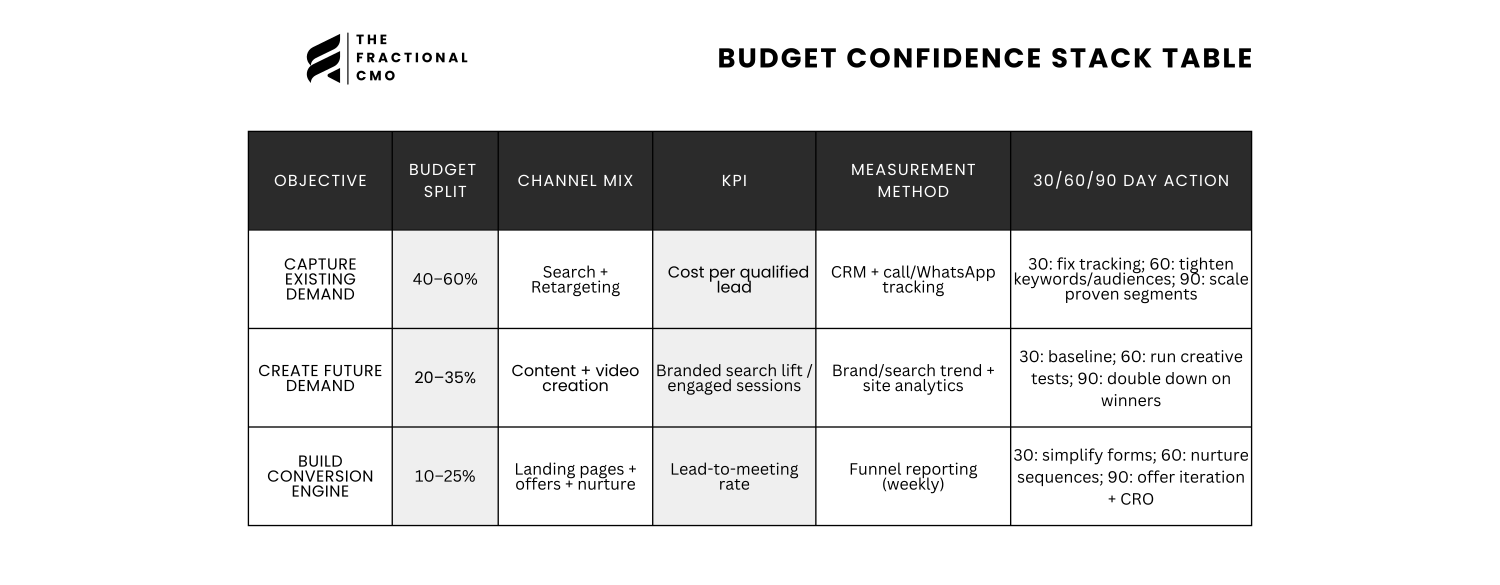
My proprietary framework: The UAE Budget Confidence Stack (BCS)
- Signal: early indicators (CTR, landing engagement, lead start rate)
- Proof: qualified lead + conversion evidence (MQL-to-SQL, cost per qualified lead)
- Scale: increased budget only after proof (budget reallocation rules)
(Adjust splits by maturity: early-stage SMEs lean heavier on capture; established brands can afford more creation.)
The Action Plan: 7 Steps to Optimize Spend and Grow
1. Audit where conversions actually happen (including WhatsApp/phone)
Expected impact: reduce “unknown attribution” and improve reallocation confidence (often 10–30% improvement in decision quality, conditional on tracking).
Time to signal: 14 days.
Pitfall: tracking only form fills.
Do today: add WhatsApp/call tracking events and force source capture in CRM.
2. Define one “North Star” KPI for paid + one for organic
Expected impact: faster optimization cycles.
Time to signal: 7–14 days.
Pitfall: too many KPIs.
Do today: choose “cost per qualified lead” (paid) + “qualified organic conversions” (organic).
3. Create a budget reallocation rule (so you’re not debating every week)
Expected impact: predictable optimization without emotion.
Time to signal: 30 days.
Pitfall: moving budget too early.
Do today: “If CPLQ is below target for 2 weeks, increase budget 20%. If above target for 2 weeks, reduce 20% and test new creative/offer.”
4. Consolidate tests: one offer test + one creative test at a time
Expected impact: clear learning, less noise.
Time to signal: 14–30 days.
Pitfall: testing everything at once.
Do today: pick one offer variable (price, bundle, guarantee) and one creative angle.
5. Shift 10–20% of spend into conversion rate optimization (CRO)
Expected impact: lower CAC without increasing spend (conditional on traffic volume).
Time to signal: 30–60 days.
Pitfall: only buying traffic.
Do today: simplify your landing page to one promise, one proof set, one CTA.
6. Plan around UAE “peaks” and intent windows
Expected impact: better ROI through timing.
Time to signal: next peak cycle.
Pitfall: flat monthly spend regardless of demand.
Do today: map your next 90 days around known peaks and align campaigns accordingly (using Google/Visa insights as a starting point).
7. Run one incrementality test per quarter (even if small)
Expected impact: higher confidence in what truly drives growth.
Time to signal: 30–45 days.
Pitfall: trusting platform attribution alone.
Do today: set up a simple geo split or holdout test inspired by conversion lift methodologies.
Conclusion
Marketing budget optimization UAE is not a finance exercise, it’s a growth system. When budgets are flat (Gartner’s 7.7% benchmark), the SMEs that win aren’t the ones chasing every channel. They’re the ones who allocate with intent, measure what matters, and reallocate faster than competitors.
5 takeaways to keep it simple:
- Optimize for confidence, not just cost.
- Track WhatsApp/phone conversions or your reporting will lie.
- Use “cost per qualified lead” and “cost per meeting,” not cheap leads.
- Build reallocation rules so decisions aren’t emotional.
- Test incrementality quarterly to prove what’s actually working.
If you want more UAE-focused frameworks like this GTM planning, funnel audits, and practical growth playbooks, explore the related articles on www.ataylorcmo.com/blogs/
For more insights on marketing strategy and business growth in Dubai and beyond, call me on +971506580240 or email: adam@ataylorcmo.com
Executive checklist
- Confirm primary goal: pipeline, revenue, retention, or awareness
- Set one paid KPI (CPLQ/CPMtg) + one organic KPI
- Implement call + WhatsApp tracking and capture source in CRM
- Map your funnel: click → lead → qualified → meeting → closed
- Allocate budget into capture / create / convert (don’t blend them)
- Write a 2-week reallocation rule (increase/decrease thresholds)
- Run one offer test and one creative test at a time
- Shift 10–20% into CRO (landing, offer, nurture)
- Plan spend around UAE intent windows and peaks
- Run an incrementality test quarterly (small is fine)
FAQs
1) What is marketing budget optimization in the UAE?
It’s the process of allocating, measuring, and reallocating marketing spend to maximize ROI and pipeline under UAE market dynamics (fast switching, high competition, WhatsApp-heavy conversion paths).
2) What KPI should UAE SMEs optimize for first?
Start with cost per qualified lead (or cost per booked meeting) because it aligns spend to sales reality better than cost per lead.
3) How much should an SME spend on marketing in the UAE?
There’s no universal number. Use benchmarks as context (e.g., Gartner’s 2025 average of 7.7% of revenue), then anchor your budget to unit economics (CAC vs LTV) and cashflow.
4) Why do my ads look good but sales don’t improve?
Attribution gaps (calls/WhatsApp), weak offer clarity, and optimizing to cheap leads can inflate platform “results” without improving revenue.
5) Is SEO or paid better for UAE growth?
Paid captures demand now; SEO compounds over time. Most SMEs need both—but sequencing matters: fix tracking and conversion first, then scale.
6) Do I need incrementality testing as an SME?
Yes, but keep it simple. Even a small quarterly holdout or geo test improves confidence and prevents wasted spend (conversion lift methods show the principle).
7) Does influencer marketing affect budget optimization in 2026?
Yes—there are compliance and operational considerations. From Feb 1, 2026, an Advertiser Permit is required for online promotions, including influencer/creator promotions, which can affect cost and risk planning.